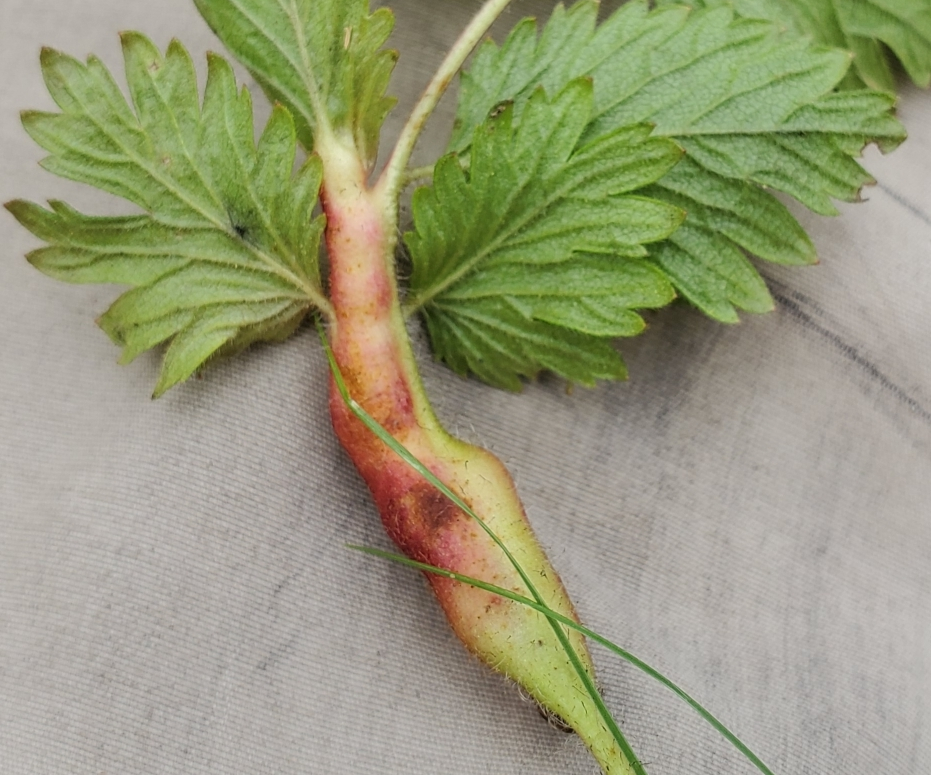
Diastrophus niger
Hosts:
Potentilla canadensis
Detachable: Integral
Color: red
Texture: pubescent, hairy
Abundance:
Shape: spindle
Season: Summer, Fall
Alignment: integral
Walls: thick
Location: petiole, stem
Form:
Cells: polythalamous
Possible Range:
Not an occurrence map: this shows where this gall's hosts grow. In most cases the
gall has not been documented throughout this area.
Loading map...
Synonymy (1)
| Name | Type | Notes |
|---|---|---|
| Diastrophus minimus | scientific |
Further Information (5)
Field Guide to the Herb and Bramble Gall Wasps of North America
- Louis Nastasi, Charles Davis
(2022)
License: CC-BY
Catalog of Rose Gall, Herb Gall, and Inquiline Gall Wasps (Hymenoptera:Cynipidae) of the United States,Canada, and Mexico
- Louis Nastasi, Andrew Deans
(2021)
License: CC-BY
Cynipid galls of the eastern United States
- LH Weld
(1959)
License: Public Domain / CC0
New Species of North American Cynipidae (1900)
- HF Bassett
(1900)
License: Public Domain / CC0
The North American Species of Diastrophus and their Galls
- William Beutenmuller
(1909)
License: Public Domain / CC0
See Also:




Created Feb 4, 2026 1:47 PM UTC
•
Last updated Feb 4, 2026 1:47 PM UTC