Druon laceyi
(agamic)agamic:The agamic (AKA unisexual) generation of an oak gall wasp (cynipini) species consists of only female wasps, which do not mate before laying the eggs which become the male and females of the sexual generation (sexgen).
View in glossary →
The gall's range is computed from the range of all hosts that the gall occurs on. In some cases we have evidence that the gall does not occur across the full range of the hosts and we will remove these places from the range. For undescribed species we will show the expected range based on hosts plus where the galls have been observed.
Our ID Notes may contain important tips necessary for distinguishing this gall
from similar galls and/or important information about the taxonomic status of
this gall inducer.
Created Feb 4, 2026 1:47 PM UTC
•
Last updated Feb 4, 2026 1:47 PM UTC
Discovery through iNaturalist: new species and new records of oak gall wasps (Hymenoptera: Cynipidae: Cynipini) from Texas, USA
Y Miles Zhang, Kimberlie Sasan, Robert O'Kennon, Adam Kranz
(2022)
Druon laceyi Zhang, Sasan & O’Kennon sp. n.
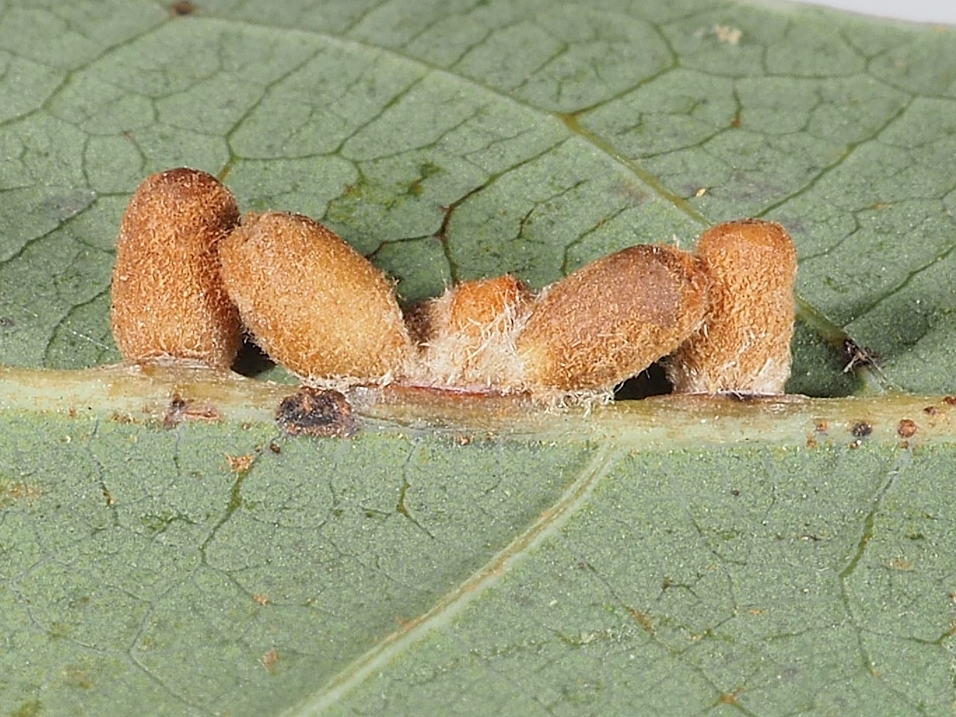
Gall. Small clusters of 1-10 individual (unilocular) brown oval cells in the center of the leaf, emerging perpendicular from the midrib on both upper and lower leaf sides of Q. laceyi in the fall (Figs. 1–2). Seen in abundance on nearly every leaf of each affected host. The cell surface when examined with a microscope shows numerous minute papillae covered with a crystalline material and sparse long white woolly hairs. The hairs weather away as the galls age, except near the base. Inside is a single thin-walled chamber (Fig. 3). Cells stay firmly attached to the leaf when it falls. Leaf petioles frequently display a small darkened area, presumably where eggs were inserted. Approximately 2–3mm long and 1.5mm in diameter. Seen in Fort Worth, TX in October. Adults emerge the following February (Fig. 4).
Biology. Only the asexual generation of this species is known, inducing aggregated detachable leaf galls on the top and bottom of the Q. laceyi. In addition to the gall inducer, inquilines (Cynipidae: Synergus Hartig, 1840) and parasitoids (Eupelmidae: Brasema Cameron, 1884 & Ormyridae: Ormyrus Westwood, 1832) have also been reared from galls of the same collection (iNaturalist observations: 66896457, 66896459, 68692701, 80260145, 80260150, 80260151, 80260156).
Distribution. Currently known only from Texas. It is possible that this species also occurs in Oklahoma and northern Mexico, where the host plant is known. Further research is necessary to establish the distribution of this species.