Limited browser support.
This browser version is not fully supported and some parts of Gallformers may not work correctly. For the best experience, update your browser. If you are using an older iPad/iPhone go yell at Apple for abandoning hardware that is still useful.
The gall's range is computed from the range of all hosts that the gall occurs on. In some cases we have evidence that the gall does not occur across the full range of the hosts and we will remove these places from the range. For undescribed species we will show the expected range based on hosts plus where the galls have been observed.
Not an occurrence map: this shows where this gall's hosts grow. In most cases the
gall has not been documented throughout this area.
Created Feb 4, 2026 1:47 PM UTC
•
Last updated Feb 22, 2026 8:53 PM UTC
Descriptions of new Cynipidae in the Collection of the Illinois State Laboratory of Natural History
CP Gillette
(1891)
Antistrophus silphii
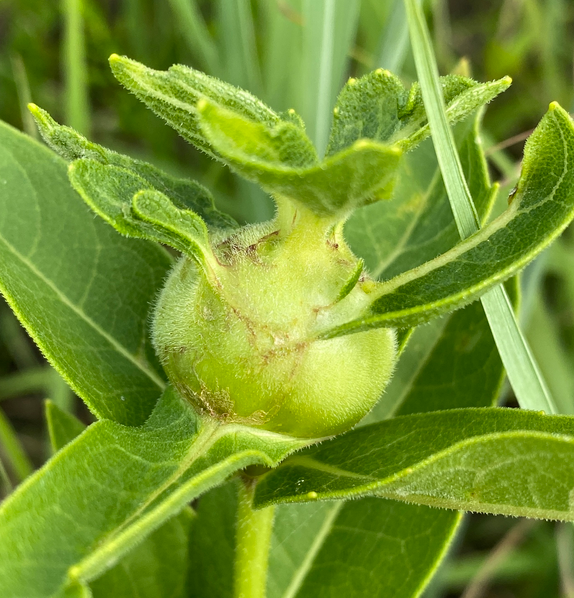
Galls. — Abrupt sub-globular swellings from 1 to If inches in diameter at the tips of the stems of Silphium integrifolium and perfoliatum (Plate IX., Fig. 1). The inner portion of the gall is made up almost entirely of a rather dense pithy material that cuts with some difficulty. Interspersed through the gall are numerous oval larval cells, and also open spaces or cavities that do not contain insects. (Plate IX.,Fig. 2.) The larval cells are not woody, as is usually the case in cynipidous galls, but their walls are of pith like the sur-rounding gall substance.
These galls are very common in the vicinity of Champaign, on stems of Silphiiim integrifolium, and Mr. Hart had collected similar galls at Normal, III, from S. perfoliatum, from which flies were reared that were in every way identical with those from galls of the other species.