Limited browser support.
This browser version is not fully supported and some parts of Gallformers may not work correctly. For the best experience, update your browser. If you are using an older iPad/iPhone go yell at Apple for abandoning hardware that is still useful.
The gall's range is computed from the range of all hosts that the gall occurs on. In some cases we have evidence that the gall does not occur across the full range of the hosts and we will remove these places from the range. For undescribed species we will show the expected range based on hosts plus where the galls have been observed.
Not an occurrence map: this shows where this gall's hosts grow. In most cases the
gall has not been documented throughout this area.
Created Feb 4, 2026 1:47 PM UTC
•
Last updated Feb 20, 2026 8:45 PM UTC
Characterizing Antistrophus gall wasps (Hymenoptera: Cynipoidea: Aulacideini) in crop silflower fields (Asteraceae: Heliantheae: Silphium integrifolium complex)
Louis F. Nastasi, Ebony G. Murrell, David Van Tassel, Eric Cassetta, Andrew R. Deans
(2025)
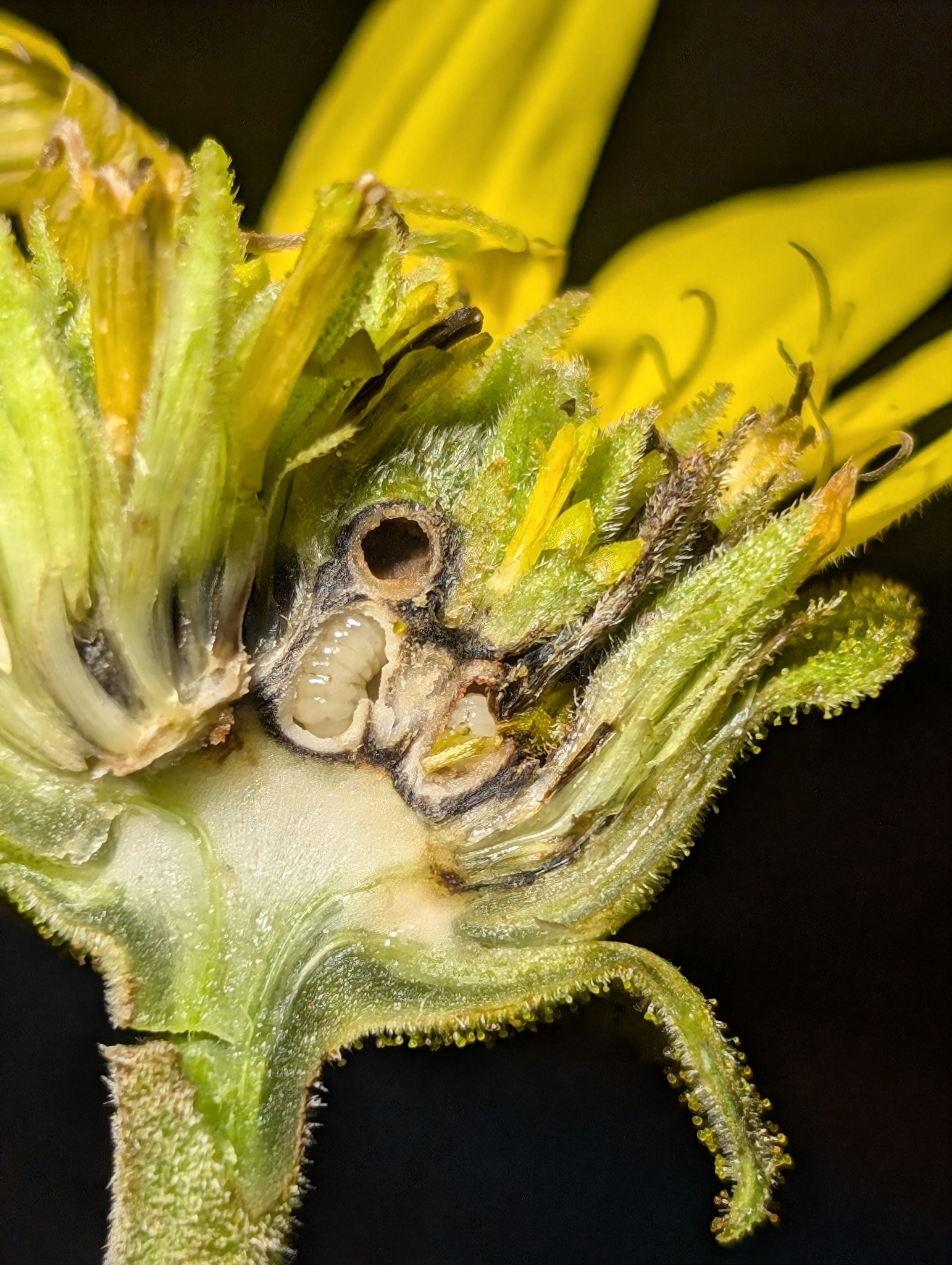
Gall (Fig. 3) – Conspicuous when in larger numbers occur within a single flowerhead; concealed within flowerhead in smaller numbers. Solitary to confluent, integral outgrowths of the disc florets, forming clusters at base of flower and fusing florets to the receptacle when numerous. Individual galls monothalamous; subelliptical; occasionally curved to clavate when heavily distorting the floret. Surface mostly smooth except for unmodified floret retained above gall tissue. Color yellow to green when fresh and tan to brown when dry. Individual galls 0.5–1 cm in length including retained floret tissue and about 0.25 cm in width; dimensions more variable when confluent but clusters usually less than 3 cm in diameter.
Secondary plant modifications – Inflorescences galled by A. bicolor are often superficially identical to those without galls. Heavily galled inflorescences may be identified by the presence of abundant modified florets (Fig. 3). The male florets in the center of the inflorescence appear to be more commonly galled than the female ray florets (Murrell, personal observation), but direct or indirect effects of infestation level on seed set have not yet been measured. Beyond alterations to the flowers, plants with abundant A. bicolor galls are not readily identifiable.
Remarks – Henderson et al. (in review) found that flower gall wasps on S. integrifolium represented A. bicolor Gillette rather than A. laciniatus as originally reported by Buffington et al. (2017). Antistrophus laciniatus is restricted to other host plant species and is morphologically distinct from A. bicolor. We compared newly reared adult wasps from flower galls with additional specimens of A. bicolor, including the holotype (Fig. 4A) and non-type specimens reared during previous studies (Buffington et al., 2017, Henderson et al., in review). All specimens were morphologically identical. While Buffington et al. reported A. bicolor from S. integrifolium, their material was also collected from the same crop silflower fields as we did in this study, albeit at different stages in the domestication process. Further consideration of taxonomic placement of crop silflower and other entities related to S. integrifolium is given in our discussion. A comprehensive discussion of flower-galling Antistrophus species, including identification keys and DNA barcode data, will be given in a forthcoming revisionary study of Aulacideini (Nastasi et al., in prep.).