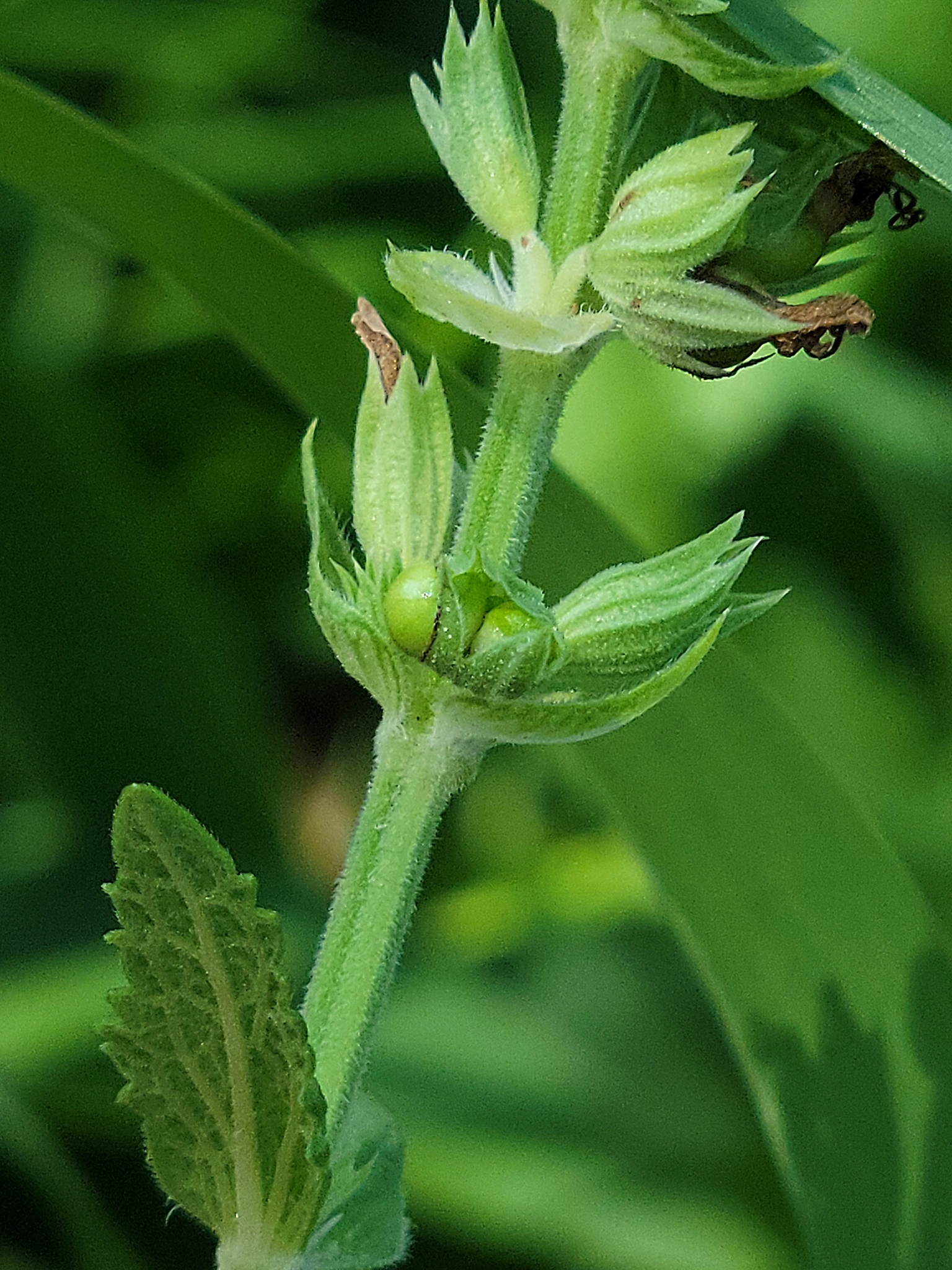
Three adult female Neaylax verbenacus were observed and collected off Salvia × digenea plants in an urban garden in Winnipeg, Manitoba, Canada. Galls were subsequently observed on the fruits, the previously known plant organ galled by N. verbenacus. Both adult wasps and galls were posted as observations to the community science platform iNaturalist (https://inaturalist.org ). Adult wasps were first observed on host plants on 5 June 2024, and galls were first observed on 7 July 2024. Collections and observations occurred throughout June, July, and August 2024 (GBIF 2024).
...
The Neaylax specimens from Winnipeg (Fig. 1) are N. verbenacus based on the diagnostic characters given by Nieves-Aldrey (1988, 2001) and Melika (2006), particularly the lack of a strong median mesoscutal impression, the complete notauli (Fig. 2), the open fore wing marginal cell, and the lack of a pilose patch on the second metasomal tergite. This combination of characters distinguishes Neaylax from all other Nearctic Aulacideini (Nastasi et al. 2024a, 2024b). Our specimens perfectly agree with the SEM images in Nieves-Aldrey (2022), especially in characters of the mesosoma. The author of the species also confirmed the identification after examining our images (see acknowledgments).
Known hosts for N. verbenacus are Salvia pratensis L. and S. verbenaca L. (Nieves-Aldrey 1988, 2001). The host plant recorded here, S. × digenea, is a hybrid of disputed parentage, but may correspond to a cross of S. amplexicaulis Lam. with either S. nemorosa L. or S. × sylvestris L. Together, these and several other sage species form a complex group that is often treated simply as S. nemorosa (Stace et al. 2015). Salvia nemorosa was previously known to host two Neaylax species, N. salviae (Giraud) and N. nemorosae (Balás), but N. verbenacus has not yet been recorded from this plant or S. × digenea (Melika 2006).
The introduction of Neaylax verbenacus to Canada was probably accidental. Neaylax have been intercepted at US ports of entry on sage plants originating from Egypt and Israel (M. Buffington, pers. comm.). No further records of adults or galls were previously known in North America. After discussing findings with members of the community, the second author deduced that the plants on which Neaylax were observed were purchased from a market and distributed by prominent nurseries in Manitoba. Whether the purchased plants were hosts of gall wasps, or gall wasps were already present in the area is unclear. Given that observations of N. verbenacus in Winnipeg were all relatively closely located, it is possible that these individuals represent a localized introduction rather than an established population.
Read more...
License:
All Rights Reserved