Limited browser support.
This browser version is not fully supported and some parts of Gallformers may not work correctly. For the best experience, update your browser. If you are using an older iPad/iPhone go yell at Apple for abandoning hardware that is still useful.
Location: upper leaf, lower leaf, on leaf veins, between leaf veins
Form:
Cells:
Possible Range:
The gall's range is computed from the range of all hosts that the gall occurs on. In some cases we have evidence that the gall does not occur across the full range of the hosts and we will remove these places from the range. For undescribed species we will show the expected range based on hosts plus where the galls have been observed.
Not an occurrence map: this shows where this gall's hosts grow. In most cases the
gall has not been documented throughout this area.
Created Feb 4, 2026 1:47 PM UTC
•
Last updated Feb 4, 2026 1:47 PM UTC
On the Insects, Coleopterous, Hymenopterous & Dipterous: Inhabiting the Galls of Certain Species of Willow. Pt 2nd and last
BD Walsh
(1866)
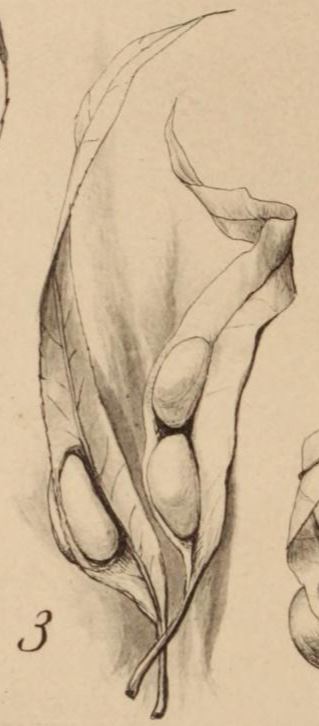
Nesmatus salicis desmodioides, n. sp.
On Salix humilis
A smooth, flattish, fleshy, sessile, yellowish-green, monothalamous gall of a semicircular outline, the chord of the semicircle adjoining the midrib of a leaf; its general shape like the seed of a Desmodium, or like the so-called "quarter" of an orange, the thin inside edge of the "quarter" closely hugging the midrib of the leaf, and the robust outer surface not biangulated but rounded off. No rosy cheek. The volume of the gall is generally about equally divided between the upper and lower sides of the leaf, but sometimes the lower portion is rather the larger. Usually there is but a single gall on a single leaf, but occasionally there are two of them either on the same side or on opposite sides of the midrib. One leaf was noticed with as many as three of these galls upon it. Length .23 — .50 inch; 131 specimens. The above is the appearance of the mature gall July 30; but on May 17 it is already nearly full-sized, and then many of them have a rosy cheek like the normal S.pomum. Abundant and not local. Distinct from S. pomum by its very different shape, and by its never having any rosy cheek when mature, and by the very distinct species of willow on which it occurs.