Limited browser support.
This browser version is not fully supported and some parts of Gallformers may not work correctly. For the best experience, update your browser. If you are using an older iPad/iPhone go yell at Apple for abandoning hardware that is still useful.
Location: upper leaf, lower leaf, on leaf veins, between leaf veins
Form:
Cells:
Possible Range:
The gall's range is computed from the range of all hosts that the gall occurs on. In some cases we have evidence that the gall does not occur across the full range of the hosts and we will remove these places from the range. For undescribed species we will show the expected range based on hosts plus where the galls have been observed.
Not an occurrence map: this shows where this gall's hosts grow. In most cases the
gall has not been documented throughout this area.
Created Feb 4, 2026 1:47 PM UTC
•
Last updated Feb 4, 2026 1:47 PM UTC
Types and biological notes of the eastern North American sawflies of Pontania Costa and Phyllocolpa Benson (Hymenoptera: Tenthredinidae) described by Marlatt, Dyar, and Rohwer
Alexey Zinovjev, David Smith
(1999)
Pontania (Eupontania) s-desmodioides
Pontania borealis
Type locality. — Plattsburgh, N.Y, according to Dyar (1898).
Host plant. — Salix humilis Marsh, as determined by G. Argus (not Salix sericea as reported by Dyar).
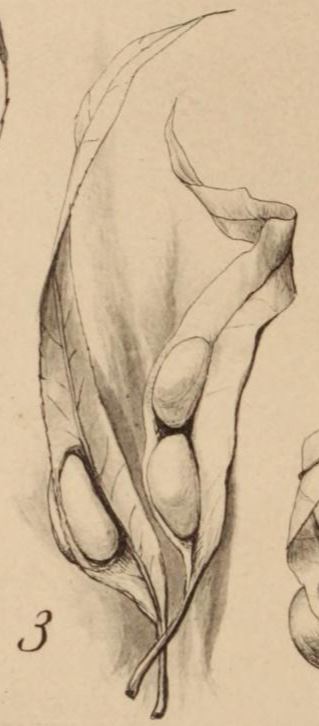
Notes. — The valid name is Pontania (Eupontania) s-desmodioides (Walsh) (= Pontania borealis Dyar, n. syn.). Dyar's (1898) description of the galls is very similar to those described by Walsh (1866) for P. s-desmodioides. The host plant was misidentified by Dyar. The remnants of leaves with the galls of this species collected by Dyar are shown in Figs. 4, 5. The leaf shape and pubescence of those associated with P. s- desmodioides is typical for Salix humilis, and the willow identification was confirmed by G. Argus. However, along with these galls of P. s-desmodioides (Figs. 4b, 5a), there are also two others on the same pins which appear to belong to P. s-pomum (Figs. 4a, 5b). A typical P. s-pomum gall is in Fig. 2. The remnants of the leaves attached to the latter two galls are glabrous and might be Salix eriocephala Michx., the host plant of P. s-pomum. However, none of the three reared females can be identified as P. (E.) s-pomum.