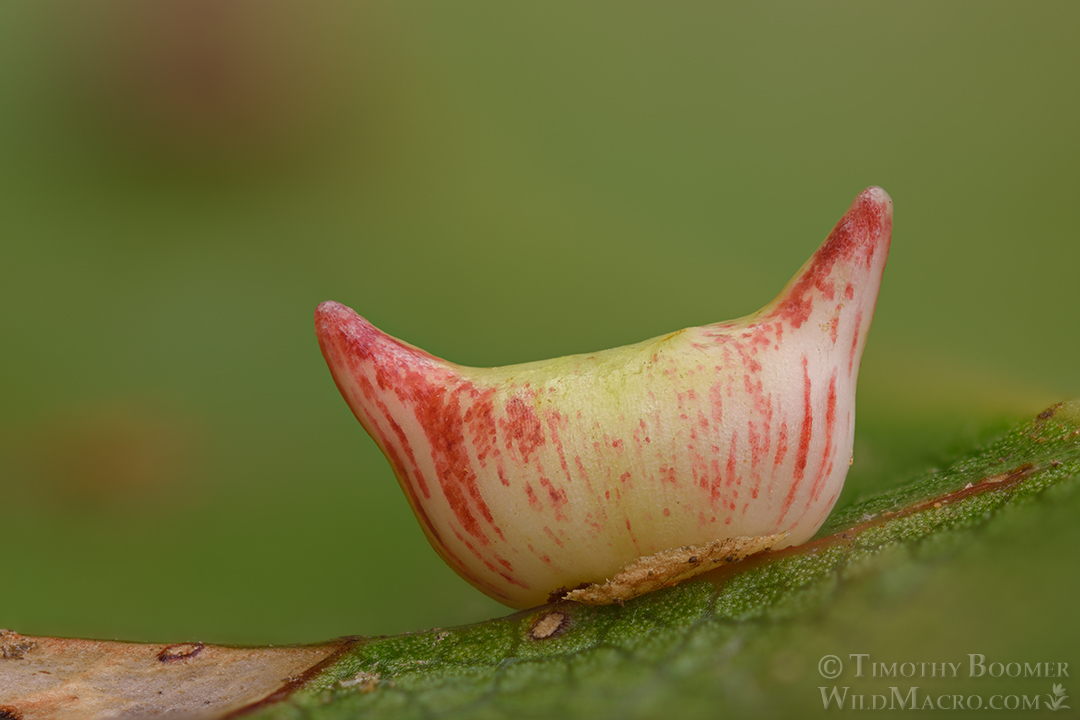
Dryocosmus dubiosus
(agamic)agamic:The agamic (AKA unisexual) generation of an oak gall wasp (cynipini) species consists of only female wasps, which do not mate before laying the eggs which become the male and females of the sexual generation (sexgen).
View in glossary →
Location: upper leaf, lower leaf, leaf midrib, on leaf veins
Form:
Cells: monothalamous
Possible Range:
The gall's range is computed from the range of all hosts that the gall occurs on. In some cases we have evidence that the gall does not occur across the full range of the hosts and we will remove these places from the range. For undescribed species we will show the expected range based on hosts plus where the galls have been observed.
Loading map...
Common Name(s):
Two-horned Gall Wasp (unisexual generation)
Our ID Notes may contain important tips necessary for distinguishing this gall
from similar galls and/or important information about the taxonomic status of
this gall inducer.
Created Feb 4, 2026 1:47 PM UTC
•
Last updated Feb 4, 2026 1:47 PM UTC
Heterogony in Dryocosmus (Hymenoptera, Cynipidae)
Richard Doutt
(1959)
Dryocosmus dubiosus (Fullaway)
Laboratory experiments show that adults of Dryocosmus dubiosus (Fullaway) reared from ament galls of the California live oak, Quercus agrifolia Nee, are bisexual. The females from this generation oviposit in the leaf veins of black oaks where they produce an agamic generation of females in characteristic bicornate galls. The females produced in these leaf galls were formerly thought to be Dryocosmus bicornis (McCracken and Egbert), but now must be considered as the agamic generation of D. dubiosus. The agamic generation is composed of two types of females, one producing only males and the other producing only females. Both generations are attacked by the parasite, Torymus fullawayi (Huber).
Agamic generation: Dryocosmus bicornis (McCracken and Egbert) was described from females cut from characteristic bicornate galls which occur on the veins on the lower surface of the leaves of Q agrifolia. The adults are all females, and are distinct from the females of D dubiosus that are bred from ament galls. The morphological differences account for their original placement in separate genera. D dubiosus was first described as a species of Diplolepis, and later it was transferred by Felt (1940) to Dryophanta. On the other hand, D bicornis was originally described as a member of the genus Callirhytis. Both species were later correctly placed in Dryocosmus by Weld (1951, 1952, 1957).
The results of breeding experiments now indicate that the supposedly separate species are in reality alternating generations of a single species. Because of priority the name to be given this single species is Dryocosmus dubiosus (Fullaway), although it does seem unfortunate to discard the particularly descriptive "bicornis."