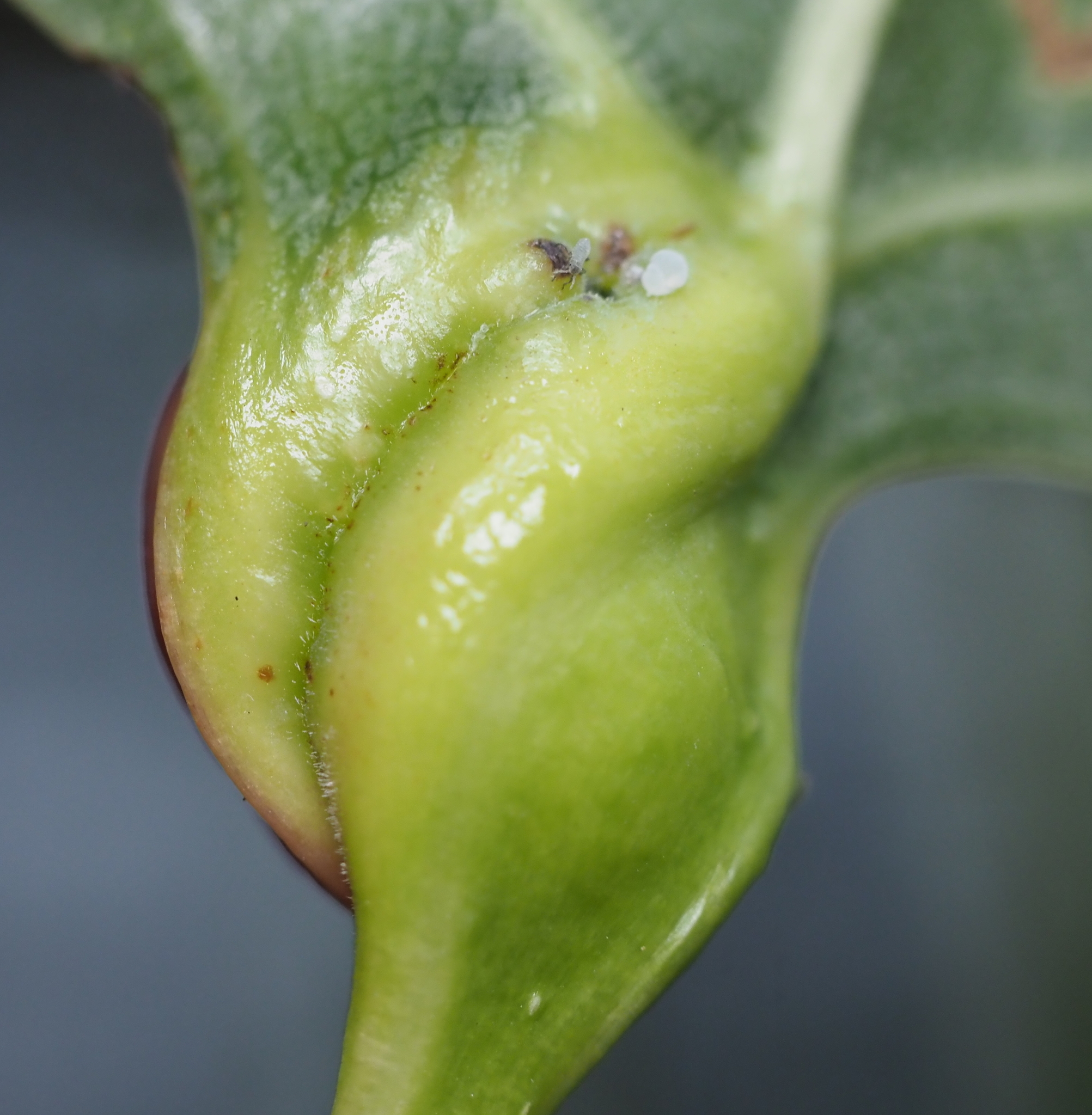
Pemphigus populi-caulis Fitch.
[Two drawings of the gall appear on page 9 of the pdf]
The Gall.—The gall is semi-globular. Large ones attain a diameter of 1/2 inch or more. Normally located galls are at the base of the leaf where the blade and petiole unite. The gall is composed of the thickened and twisted petiole and a very small portion of the base of the leaf blade which frequently extends a short distance down onto the gall. The greater part of the gall extends below the plane of the leaf blade. Viewed from above the mouth is normally not visible and the midrib and the first diagonal veins on either side are seen to merge into the body of the gall.
When viewed from below the midrib is seen to bend abruptly and to merge with a ridge formed by the edge of the petiole which follows the curve of the gall and forms a part of one lip of the opening. The other lip of the opening is formed by a fold in the base of the leaf blade for a part of its length and the balance by the edge of the petiole. The petiole is twisted so that the flattened portion lies in nearly the same plane as the leaf blade instead of at right angles to it as in normal leaves. It is clear that almost the entire gall is made up of the much enlarged and twisted petiole. The mouth is usually full-lipped and extends more or less in a spiral fully 2/3 the distance around the gall. Many times there is a small round opening at some point along the lips through which the winged lice escape. The senior author has collected aphids which correspond in every respect to P. p. -caulis, from galls similar to those produced by P p.-venae at Oak Park MN, and in the Bitter Root Valley in MT. These were from Populus balsamifera trees heavily infested with P p-globuli and P. p-venae. It seems than under certain conditions at least P. p-caulis produces galls on the leaf similar to those produced by P. p.-venae.
This aphid was very abundant in Logan during the spring of 1925. The infestation was so severe that by July 1st many leaves had fallen from the infested poplars, Populus balsamifera and P deltoides. About 3 percent of the leaves remaining on the trees were infested with galls.
The aphids are ordinarily very numerous in these galls, and sometimes a hundred or more pupal nymphs and winged females in addition to the stem-mother are present in a single cell. Ordinarily, there is a large drop of liquid in the bottom of the gall. The waxy material secreted by the wax glands makes the inside of the gall grayish so that when it is opened, the moving aphids appear to be mixed up in a growth of fungus.
In addition to being present in Logan, this aphid was also found in Big Cottonwood Canyon, Utah, on June 29, 1925, where it was producing its characteristic galls. it has also been collected at Hyde Park during early July, 1928.
Notes:
Pemphigus populi-caulis and Pemphigus populi-globuli were described by Dr. Asa Fitch in the " Report of the Noxious and Other Insects of the State of New York," 1859.
Fitch's descriptions of the insects are too meager to make a separation of the species certain without the galls.
The gall produced by the aphis Fitch described as P. p.-caulis is described as a "bullet-like gall " on the middle of a leaf stalk from a Lombardy poplar. This gall was found on the 27th of June, three years before the description of P. p.-caulis was publishéd.
Discussing the gall further, Fitch says: "When the leaves fell from this tree in autumn, a few were found among them, more faded than the others and having these same excrescences, but placed at the base of the leaf instead of on the middle of its stem"
Farther on in his discussion, Fitch states: "Galls analagous to those here described grow upon the leaf stalks of the Lombardy and Black poplar in Europe, from attacks of the Pemphigus bursarius of Linnaeus. "
After comparing it with specimens of that species and its galls, Fitch considered his aphid different from P. bursarius, the fly being paler in its color, and its gall because of spirally coiled somewhat like the shell of a snail."
It is very evident from Fitch's discussion that he had in mind, when he described P. p.-caulis, a gall located on the petiole of the leaf at some distance from the leafblade, and one produced by a twisting of the petiole into a spiral.
It is quite probable that the petiole gall described by Fitch is not typical of P. p.-caulis, but that those at the the base of leaf which he mentions as being taken in the fall are the typically located galls.
The aphid herein figured and described as Pemphigus populi-caulis is from galls located at the base of the leaf and produced by a twisting or spiralling of the petiole. The species described as P. p.-globuli, is considered to be the globuli of Fitch because of the likeness of its gall to the one described by Fitch in his discussion of that species.
Since the original descriptions of P. P.-caulis and P. P.-globuli were published these species have received much attention, if we may judge from the frequent references to both. However, in spite of this, several aphidologists appear to have failed to distinguish between them.
P. p.-caulis and P. p.-globuli are very similar structurally and their galls are, in a general way, much alike, although quite different when studied in detail. This general similarity of both the aphids and their galls appears to have caused considerable confusion in the literature. This was probably increased by a lack of detail in the earlier descriptions.
In studying the two species under discussion, the senior author has collected material from several states and in many localities in some of these states. When collections of both species have been made in the same locality, they rarely have been found on the same host species. In Colorado and Utah P. p.-caulis was taken on Populus deltoides and P. p.-globuli on Populus angustifolia and Populus balsamifera. In California P. p.-caulis was taken on Populus Fremontii and P. p.-globuli on Populus trichocarpa. P. p. -caulis was taken on Populus deltoides at St. Cloud, Minnesota, and both species on Populus balsamifera at Oak Park, Minnesota. East of the Rocky Mountains in Montana P. p.-caulis was taken on Populus deltoides and P. p.-globuli on Populus angustifolia. P. p.-caulis was taken on Populus balsamifera in the Bitter Root Valley of Western Montana and P. p.-globuli on the same species of Populus near the Flat Head Lake. The junior author reports both species on Populus balsamifera. These observations appear to indicate that Populus balsamifera is the only common host of P. p.-caulis and P. p.-globuli east of the Rocky Mountains. Populus trichocarpa may serve as a host for both in the range of this tree.
These collections have been carefully separated according to the type of gall and a large series of the aphids from each gall type critically studied. These studies have brought to light certain structural differences by which P. p.-caulis and P. p.-globuli alate forms from the galls may be separated. These differences are constant in relative magnitude but not in actual magnitude.
Both species under discussion are quite variable in size and in some other characters. This necessitates studying several individuals and comparing the means of characters in order successfully to separate them. When a sufficient number of individuals to make a representative population is studied, separation becomes easy and certain.
Thomas, in the "Third Annual Report on Noxious and Beneficial Insects of Illinois," 1879, pictures a typical Pemp. populi-globuli gall for the gall of Pem. populi-caulis. Dr. O. W. Oestlund described Pem. populi-caulis in his synopsis of the Aphididæ of Minnesota. His description is not sufficiently detailed to determine which of the two species under discussion he really had. The host is given as Populus monilifera.
Essig, in Pomona College Journal of Entomology, 1912 describes and illustrates Pem. populi-caulis and several galls. These galls are of 3 quite distinct types. One is typical galls. of Pem. p.-caulis. Several are typical Pem. p.-globuli and one is typical of what the senior author is calling Pem. p-venae. The senior author has collected all three types of galls on Populus trichocarpa in California. The aphids from the typical Pem. p.-globuli and Pem. p.-caulis were the ones used in the studies already referred to. The ones from the other type of gall do not fit with either Pem. p.-caulis or Pem. p.-globuli. Several collections of these galls have been made in Minnesota. The aphids from Minnesota differ from the species being discussed in the same way as those from California. This species is described later as Penz. P.-venae. The descriptions of Essig are not sufficiently detailed to enable one to determine his species with certainty. However, his figures of the antenna, of the alate viviporous female and the stem mother are typical of Pem. p.-caulis.
It seems quite probable that Essig failed to separate the 3 species in his material.
Dr. Edith M. Patch described Pem. populi-caulis from Populus balsamifera and pictures 1 typical Pem. populi-globuli gall and 2 not typical of this species or of Pem. populi-caulis. The latter are similar to galls taken by the senior author at Oak Park, Minnesota, produced by what he calls Pem. populi- venæ.