Limited browser support.
This browser version is not fully supported and some parts of Gallformers may not work correctly. For the best experience, update your browser. If you are using an older iPad/iPhone go yell at Apple for abandoning hardware that is still useful.
Neuroterus saltatorius
(sexgen)sexgen:The sexual generation (AKA bisexual generation or sexgen) of an oak gall wasp (cynipini) species consists of both male and female wasps, which mate before the females lay eggs which will mature to form the all-female agamic generation.
View in glossary →
The gall's range is computed from the range of all hosts that the gall occurs on. In some cases we have evidence that the gall does not occur across the full range of the hosts and we will remove these places from the range. For undescribed species we will show the expected range based on hosts plus where the galls have been observed.
Not an occurrence map: this shows where this gall's hosts grow. In most cases the
gall has not been documented throughout this area.
Loading map...
Common Name(s):
California Jumping Gall Wasp, Jumping Gall Wasp (bisexual generation)
Our ID Notes may contain important tips necessary for distinguishing this gall
from similar galls and/or important information about the taxonomic status of
this gall inducer.
Created Feb 4, 2026 1:47 PM UTC
•
Last updated Feb 4, 2026 1:47 PM UTC
New Pacific Coast Cynipidae (Hymenoptera)
Alfred Charles Kinsey
(1922)
Neuroterus decipiens, new species
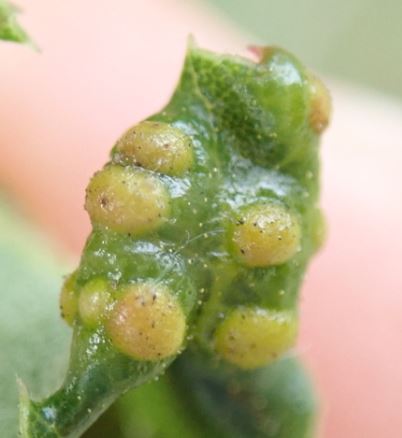
GALLS (P1. XXIV; Fig. 9).-Clusters of egg-like cells in the leaf-blade. Each cell monothalamous, oval, about 1.7 mm. long by 1.0 mm. wide, thin-walled, entirely hollow, equally protruding from either surface of the leaf; leaf-green, drying brownish yellow. In dense, compacted clusters containing many scores of cells; on young leaves of Quercus Douglasii.
RANGE.-California: Stanford University (I. C. McCracken, Coll.), Three Rivers, and Redding.
This species is very abundant early in the spring; the galls are very succulent and the insects mature quickly after the unfolding of the leaves. There must be, therefore, another generation in the year, probably agamic. Insects were emerging at Three Rivers on March 22, but some hundred miles farther north, at Redding, adults did not emerge until some time after collection of the galls on April.2. Of 93 adults of my collection, only 14 are males, not the usual ratio for bisexual generations of this genus. Material of this species is in several collections labelled Neuroterus pacificus Beutenmuller, but this is obviously not that species.