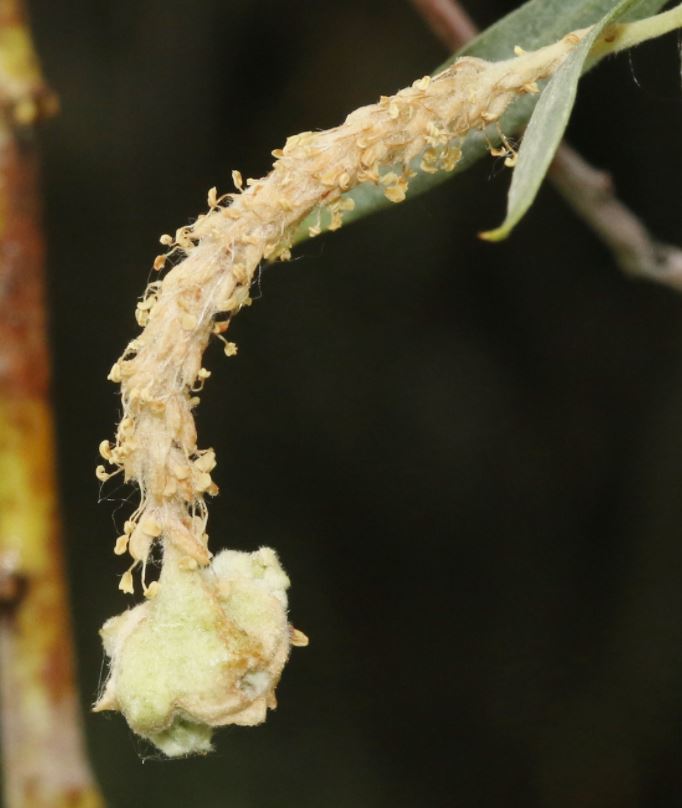
S aenigma, n. sp.
On S nigra
A polythalamous, crumpled, irregularly spherical or ellipsoidal mass, something like the aborted mass of flower-buds of a common cauliflower, but with a more ragged and uneven surface, .30 — 1.10 inch in diameter, and growing almost sessile or sometimes on a stem as long as .50 inch, which is often branched and much flattened or distorted, from the side or occasionally from the tip of twigs .05 —.30 inch in diameter. When cut into early in the summer, there is seen to be no regular heart or symmetrical arrangement of the parts, as there is in all monothalamous galls, and the stem is crisp and rather fleshy than woody. This gall first appears early in June, being chiefly a deformation of the flower-catkins, but occasionally, unless I was deceived from confounding it with S. semen n. sp., which I think must have been the case, of the leaves. At that time, and for a month or two afterwards, it is of a pale green, but long before autumn it dries up and becomes brittle and of a dark ash-gray color, without, however, losing its original shape, and hangs on the trees till long after the next spring opens. It contains, so far as I could discover, no regular cells, but the larvae of the Gall-gnat appear to burrow irregularly in the main stem and its branches. On the same twig may often be seen 6 or 8 of these galls at irregular intervals of half an inch or U inches, and frequently two of them grow side by side and run together. "Whole trees are sometimes so covered by them, that the galls seem almost half as numerous as the leaves. As usual, the twigs, unless very large, are killed by the presence of these galls shortly after the galls have become mature.
Described from 150 — 200 specimens. Very common and abundant everywhere in Rock Island County, Illinois.